
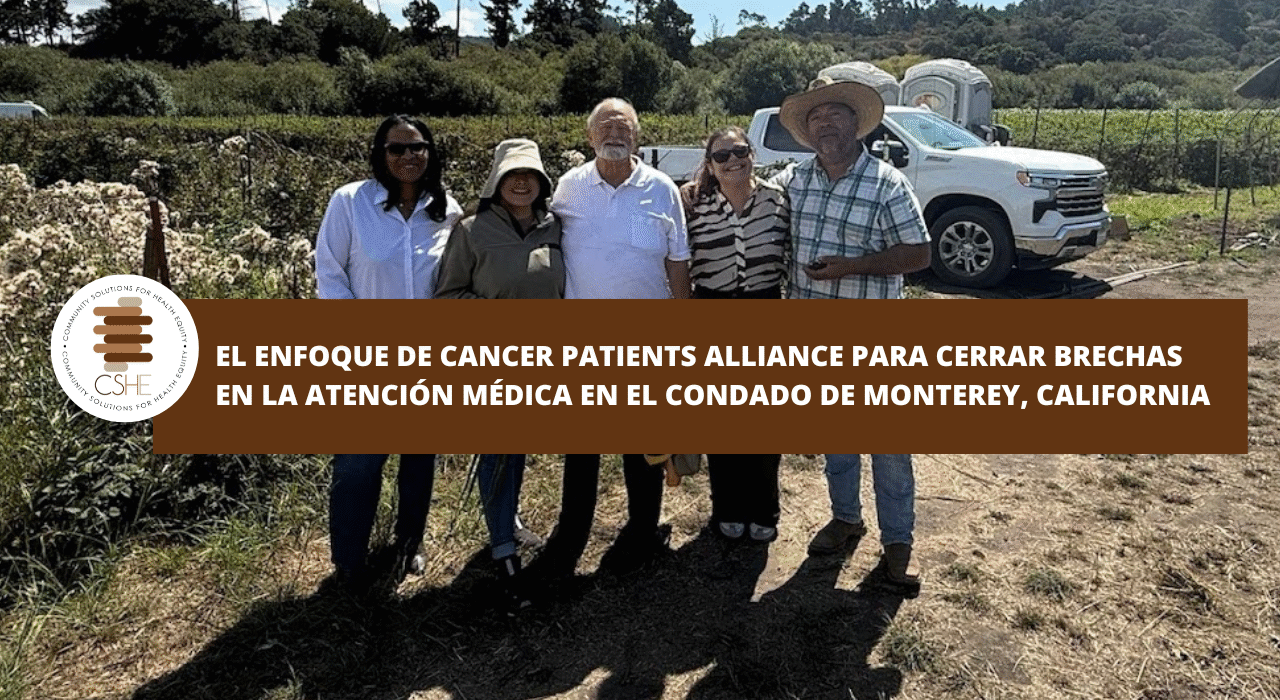

During Hispanic Heritage Month, celebrated annually September 15 to October 15, CSHE had the privilege of visiting Cancer Patients Alliance (CPA) in Monterey County, California. What we witnessed was a masterclass in community-centered systems change—a powerful example of what happens when organizations trust community members to identify problems, design solutions, and lead the charge for transformation.
During Hispanic Heritage Month, celebrated annually September 15 to October 15, CSHE had the privilege of visiting Cancer Patients Alliance (CPA) in Monterey County, California. What we witnessed was a masterclass in community-centered systems change—a powerful example of what happens when organizations trust community members to identify problems, design solutions, and lead the charge for transformation.
Cancer Patients Alliance was founded in 2001 by physicians and community members who recognized a critical gap: cancer patients in certain communities lacked sufficient, reliable information to become active partners in their own medical care. But CPA understood something essential from the start—you cannot close healthcare gaps by simply providing more information. You have to transform the systems that create those gaps in the first place; and you cannot transform systems without centering the voices and wisdom of the people that these systems are failing.
The Reality in California’s Fields
In the heart of California’s Salinas Valley—where nearly half of the country’s vegetables and over three-quarters of the country’s fruits and nuts are grown—there exists a painful contradiction. The immigrant farmworkers who feed our nation face systemic barriers to accessing the very healthcare systems that should serve them. Language barriers, inadequate wages from larger farming companies and distribution centers, fear related to immigration status, lack of transportation, and discrimination all stand between these workers and cancer care that could save their lives.
These are not problems that can be solved by healthcare systems alone. They require community-led solutions, shared decision making , cultural humility, policy changes, and a fundamental reimagining of how systems serve people rather than the other way around.

Building Bridges Through Community Voice
CPA’s work focuses on building bridges between immigrant farmworkers and healthcare systems through a community-driven approach that breaks down taboos, educates about cancer prevention and treatment, and empowers patients to become active partners in their care. But the heart of their work lies in how they engage community members themselves as the architects of change.
“When you come to the realization that something needs to be done for cancer care, especially for underserved populations, you feel like you have to do something,” says Lluvia, a CPA team member. But rather than deciding what that “something” should be from a distance, CPA goes directly to the source.”
“We know the barriers: language, access, healthcare, money, transportation, support… but aside from that, now we’re really talking to real patients that are going through it. Every person has a story and it’s a real story,” Lluvia explains. This practice of deep listening—of treating community members as experts in their own experiences—exemplifies what CSHE calls bi-directional learning: entering every space as both student and teacher, honoring that community wisdom and academic insight hold equal value.
CPA doesn’t just study the problem; they sit with people living it. They create space for stories to be shared, for barriers to be named, and for solutions to emerge from the community itself. “This work has allowed me to understand more. But we have to let the community know they are not alone,” Lluvia reflects.
From Storytelling to Systems Change
During CSHE 1.0 from 2021-2023, CPA channeled the stories and experiences of community members into a powerful tool for advocacy: a video that gave voice to the Latine community’s experiences navigating cancer care. This wasn’t just a documentation project—it was an act of radical transparency, creating space for the community to speak their truth with the intention of generating real dialogue and accountability.
The video raised awareness about the clear gap in services provided for the Latine community, and its impact was profound. County hospital policies changed. Doors that had been closed began to open.
“We feel like we’ve been invited to the table,” shared Dale, reflecting on this transformation. “And really this came about as a result of CSHE because I don’t think we would’ve been here except for that video. And we wouldn’t have had that video except for CSHE. I’m astounded at the progress that we’ve made.”
This is systems change in action—not a report gathering dust on a shelf, but community voices compelling decision-makers to act. CPA’s approach demonstrates what we at CSHE know to be true: when you center community in your process, you shape outcomes that actually address community needs. This intentionality—being purposeful and deliberate while trusting that communities already possess what they need to create meaningful change—transforms advocacy from abstract to concrete.
Creating Space for Cultural Identity and Healing
One of the most powerful aspects of CPA’s work is how they create space for cultural identity to be a source of strength in the healing process. In many healthcare settings, immigrant patients are expected to navigate systems that neither understand nor honor their cultural backgrounds. CPA flips this dynamic.
“I love the culturally rich aspect to [CSHE],” Lluvia shared. “CSHE allows us to be accepting of who we are; our backgrounds. It’s allowed me to be more connected to my culture, my ancestors, and it allows me to share that with my community and teach my kids too.”
By creating space where people can show up as their whole selves—where speaking Spanish isn’t a barrier but a bridge, where cultural practices around illness and healing are honored rather than dismissed— CSHE practices multicultural solidarity. We maintain and celebrate the unique identities of ethnically diverse groups while working together toward systems transformation.
CPA shows us that when patients feel seen, respected, and valued in their full cultural identity, they’re more likely to seek care, ask questions, advocate for themselves, and persist through treatment. Culture isn’t separate from healthcare—it’s foundational to it.

The Path Forward: Community as Solution
Our visit to Cancer Patients Alliance confirmed what we at CSHE have learned through our community-connected practice: centering community needs and voices is not an added layer of compliance. It is the only way true and sustainable change can happen.
CPA is doing this work every day in Monterey County. They’re tackling factors that contribute to hesitation in seeking cancer care within immigrant communities. They’re educating families about prevention and treatment options. They’re training community members to become health advocates. They’re advocating for change in hospital policies to be more inclusive and responsive. And most importantly, they’re ensuring that the people most impacted by healthcare gaps are the ones leading the way toward closing them.
Their approaches build collaborations with organizations and health providers while engaging community members to design solutions that address the real barriers they face. The result is not just better healthcare access—it’s a model for how systems transformation actually happens.
CPA embodies CSHE’s community-connected approach in their work by building collaborations with organizations to improve health outcomes for cancer patients through education, addressing health disparities, and providing support and resources for patients and their families. Their work reflects the shared wisdom and relationships that shape CSHE’s approach — demonstrating how knowledge shared and created within a rich, multicultural community can lead to more holistic and transformative healthcare systems.
Cancer Patients Alliance embodies CSHE’s community-connected approach by building collaborations with organizations. They work to improve health outcomes for cancer patients through education, addressing health disparities, and providing support and resources for patients and their families.
CPA trusts that the community already has the answers — amplifying community voices until systems listen and respond — all while honoring the rich multiculturalism and wisdom that immigrant communities bring to the table. Their work reflects the shared relationships and collective knowledge that drive holistic, community-rooted healthcare systems transformation and exemplify CSHE’s approach.
The farmworkers of Monterey County feed our nation. Cancer Patients Alliance is working to ensure that when they need care, the systems respond with the same generosity, dignity, and respect that these workers bring to their labor every single day.
Cancer Patients Alliance continues to work with communities across Monterey County to improve health outcomes through cancer education, addressing health disparities, and enabling cancer patients and their families to become active partners in their medical care.